
We live in a world where we are constantly being told that we need more of everything.
More money, more food, more space, more possessions. But what if the secret to living an abundant life is right in front of us?
A lovely friend of mine once invited me to join a 21-day abundance meditation course led by Deepak Chopra. The website entices potential students with promises to:
“Fulfill your deepest desires and effortlessly attract anything you wish.”
I’m ashamed to say, I didn’t last very long. Mainly because it involved homework, and I have learnt many times over that I am not good with homework. I have to admit, there was probably another reason I didn’t stick to it. According to its definition, abundance means ‘an overflowing quantity or supply’.
Do I really want more than I need? And do I really believe that what I want can be achieved without effort?
Finding abundance in unexpected moments
But the idea of abundance was not done with me yet. Not long after I had bombed out of the abundance meditation course, another friend and I were having breakfast after our weekly swim. We were drinking coffee and commiserating over the challenges we were facing; reduced work hours, cramped apartments, confusing love lives. She suggested that we close our eyes and “invite in some abundance”.
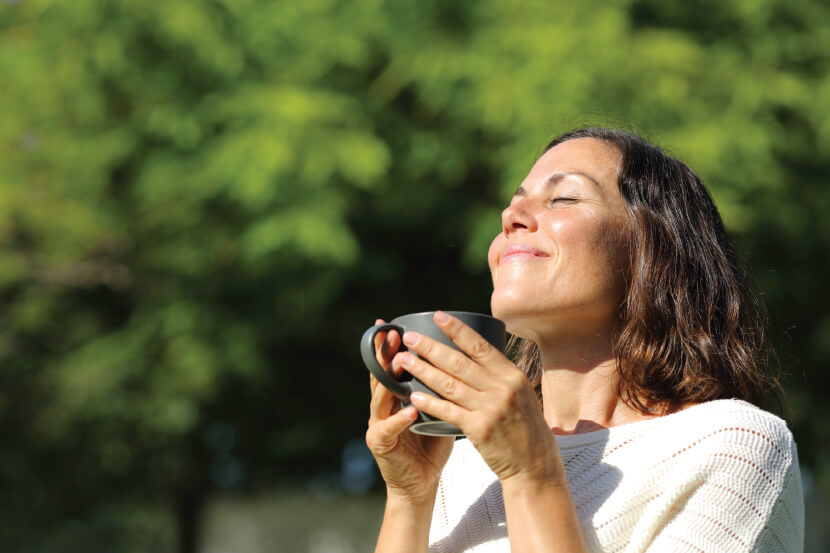
This was much more appealing than 21 days of practice, so I closed my eyes and turned my face toward the sun. But at that moment I could not ‘invite’ anything in. All I could think about was what I already had.
 Escaping the scarcity mindset
Back when my children were very small, I started to sink into a scarcity mindset My world had shrunk to our apartment’s walls, and there never seemed enough of anything. There was never enough sleep, enough space, enough time, and definitely not enough money.
I found myself talking to my siblings (who also had young children) and not having enough became a competitive sport. It became a toxic race to the bottom of who was having the hardest time. We were all competing for a prize no one wanted. It woke me up and changed my perspective.
All of a sudden, it shone a light on all the aspects of life we weren’t comparing. Our snug, warm homes, the food on our table, our loving relationships, and our healthy and happy kids. None of which indicated a scarcity of resources.
In a fleeting moment of reverie, I noticed how warm the sun felt on my face, how good my body felt after a swim, and how I was going home to share the weekend with my family.
How gratitude can reframe your reality
Psychologist Rosie Barr says cognitive reframing, the scientific way of seeing the world with your glass half full, can help to change our internal narrative. “Rather than lament about what we don’t have in our lives (such as enough money, enough time, or enough love), we shift our perspective to what we can control, what we do have, what is abundant or what there is to be grateful for.
“In fact, many psychological studies have shown that once our basic material needs are satisfied, our level of income makes no difference to our level of happiness. In other words, rather than accumulating and desiring more to attain wellbeing, we may need to turn inwards and examine our relationship with our thoughts and with ourselves.”
Why gratitude makes life feel fuller
Robert Emmons is a psychologist and professor, and director of Gratitude Works, a faculty dedicated to the long-term study of the impact of gratitude, at the University of California.
A gratitude questionnaire conducted by Emmons at the university in 2011 found that,
“Grateful individuals place less importance on material goods, they are less likely to judge their own and others’ success in terms of possessions accumulated, they are less envious of others, and are more likely to share their possessions with others relative to less grateful persons.”

When positivity isn’t the whole story
Revered mindfulness author Eckhart Tolle said, “Acknowledging the good that you already have in your life is the foundation for all abundance.” Yet positive thinking, no matter how you look at it, has its limits.
As Barr says, “It’s argued that turning to positivity solutions ignores the structural failures of the system that benefits a few and is deeply alienating to many.” After all, the things that I’ve come to appreciate that symbolise an abundant life – the roof over my head, nutritious food, happy children – are all things that, through immense privilege, I was born into, and supplementarily gained through hard work.
Dr Joe Dispenza is a New York Times best-selling author, lecturer, and corporate consultant whose research-based practices guide people to generate more abundance in their lives. He says,
“By changing your perception from lack – thinking you are separate from what you want – to feeling everything is already here, you should start to see your life shift in mysterious ways.”
Reflecting on the day by the ocean with my friend, there were things that I could have wished for: more work hours, more space for my family, more time for myself. Viewing through a socially conditioned lens, these are all factors that comprised a better life. But in a fleeting moment of reverie, I noticed how warm the sun felt on my face, how good my body felt after a swim, and how I was going home to share the weekend with my family. I felt content with everything I already had. I am lucky, and I am grateful.
And as for the homework, well, I’m going to need to work on that.
The ancient origins of abundance
Abundance comes from the Latin abundantia, meaning ‘fullness’ or ‘plenty’ – which was also the name of the ancient Roman goddess who was the divine personification of prosperity. Abundantia featured in art and literature, and was an embodiment of virtue in propaganda that portrayed Roman emperors as the extension of godliness on Earth. She would occasionally be depicted holding wheat or standing on a ship, but most commonly appeared on coinage with an overflowing cornucopia. From the Latin cornu (horn) and copia (abundance), the cornucopia was also known as the horn of plenty in classical antiquity. Abundantia was also alternatively known by the name Copia.
WORDS: Shevonne Hunt
This article was originally published under the title A Little Abundance in Issue 39 – A Little Abundance. You can purchase previous issues and enjoy more enchanting content here.